
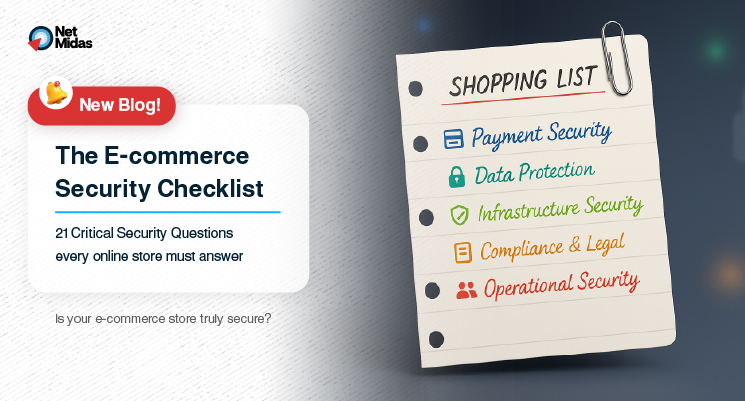
The E-commerce Security Checklist
21 critical security questions every online store must answer, across payments, data, infrastructure, compliance, and operations.
Overview
This comprehensive checklist addresses critical security considerations for online retailers. The guide provides actionable recommendations across five core security domains, helping store owners identify and address potential vulnerabilities.
1. Payment & Financial Security
Question 1.1: Do you use PCI DSS compliant payment processing? Partner with certified payment processors like Stripe, Square, or PayPal. Avoid storing credit card information on your servers; instead, implement tokenization for recurring charges.
Question 1.2: Are all payment pages secured with SSL certificates? Install SSL certificates across your entire site, not merely at checkout. Display security badges prominently and configure HTTPS redirects for all HTTP traffic.
Question 1.3: Do you have fraud detection systems in place? Deploy real-time fraud scoring, velocity checks, and geolocation verification with automated alerts for suspicious transactions.
Question 1.4: How do you handle refunds and chargebacks securely? Establish transparent refund policies, maintain comprehensive transaction logs, and utilize chargeback prevention tools while documenting all customer interactions.
Question 1.5: Are your financial reports and customer payment data encrypted? Use AES-256 encryption for stored data and implement end-to-end encryption for data transmission, with regular encryption protocol audits.
2. Customer Data Protection
Question 2.6: How do you collect and store customer personal information? Gather only essential data using secure, encrypted databases with established data retention and automatic deletion schedules.
Question 2.7: Do you have explicit consent for data collection and marketing? Create clear opt-in checkboxes, maintain consent records, and provide straightforward opt-out mechanisms with documented preferences.
Question 2.8: Can customers access, modify, or delete their personal data? Build customer portals enabling data management and implement procedures supporting the "right to be forgotten," responding to requests within legal timeframes.
Question 2.9: How do you handle data breaches? Develop incident response plans establishing breach notification procedures and maintaining forensic capabilities; practice breach scenarios regularly.
Question 2.10: Do you share customer data with third parties? Audit all data-sharing agreements, ensure third-party compliance, maintain data processing records, and conduct vendor security assessments.
3. Website & Infrastructure Security
Question 3.11: Is your website protected against common attacks (SQL injection, XSS, CSRF)? Deploy a Web Application Firewall, conduct regular penetration testing, adopt secure coding practices, and promptly apply security patches.
Question 3.12: Do you have secure user authentication and session management? Enforce strong password policies, implement multi-factor authentication, and utilize secure session tokens with appropriate expiration settings.
Question 3.13: Are your servers and hosting environment secure? Select reputable hosting providers with security certifications; implement server hardening, regular updates, and access controls.
Question 3.14: Do you regularly backup your data and test recovery procedures? Automate daily backups, store offsite copies, and test restoration monthly, documenting recovery time objectives.
Question 3.15: How do you monitor for security threats and vulnerabilities? Deploy monitoring tools with automated alerts, conduct regular vulnerability scans, and maintain security logs for analysis.
4. Compliance & Legal Requirements
Question 4.16: Are you compliant with GDPR, CCPA, and other privacy regulations? Create comprehensive privacy policies, implement data protection procedures, and conduct privacy impact assessments for new features.
Question 4.17: Do you collect and remit sales tax properly in all jurisdictions? Use automated tax calculation software, register in states with nexus, and maintain detailed transaction records for audit purposes.
Question 4.18: Are your terms of service and privacy policies current and legally compliant? Review policies annually with legal counsel, update for regulatory changes, and ensure clear, accessible language.
Question 4.19: Do you have proper business licenses and permits for all markets? Research jurisdiction-specific requirements, maintain current registrations, and monitor for new compliance obligations.
5. Operational Security
Question 5.20: How do you secure employee access to sensitive systems and data? Implement role-based access controls, conduct background checks, provide security training, and apply the principle of least privilege.
Question 5.21: Do you have incident response and business continuity plans? Create detailed response procedures, establish communication protocols, test plans quarterly, and maintain emergency contact lists.
Security Risk Assessment
Score your security:
- 18-21 answers: Strong security posture
- 12-17 answers: Moderate risk — address gaps immediately
- 6-11 answers: High risk — requires urgent attention
- 0-5 answers: Critical risk — seek professional help immediately
Quick Action Priority Matrix
Critical (Fix Immediately):
- PCI DSS compliance
- SSL certificate implementation
- Data encryption protocols
- Basic fraud detection
High Priority (Fix This Month):
- Privacy policy updates
- Employee access controls
- Backup and recovery testing
- Vulnerability scanning
Important (Fix This Quarter):
- Advanced monitoring systems
- Penetration testing
- Compliance audits
- Security training programs
The smartest move is a professional cybersecurity audit to identify compliance gaps before attackers — or regulators — do.